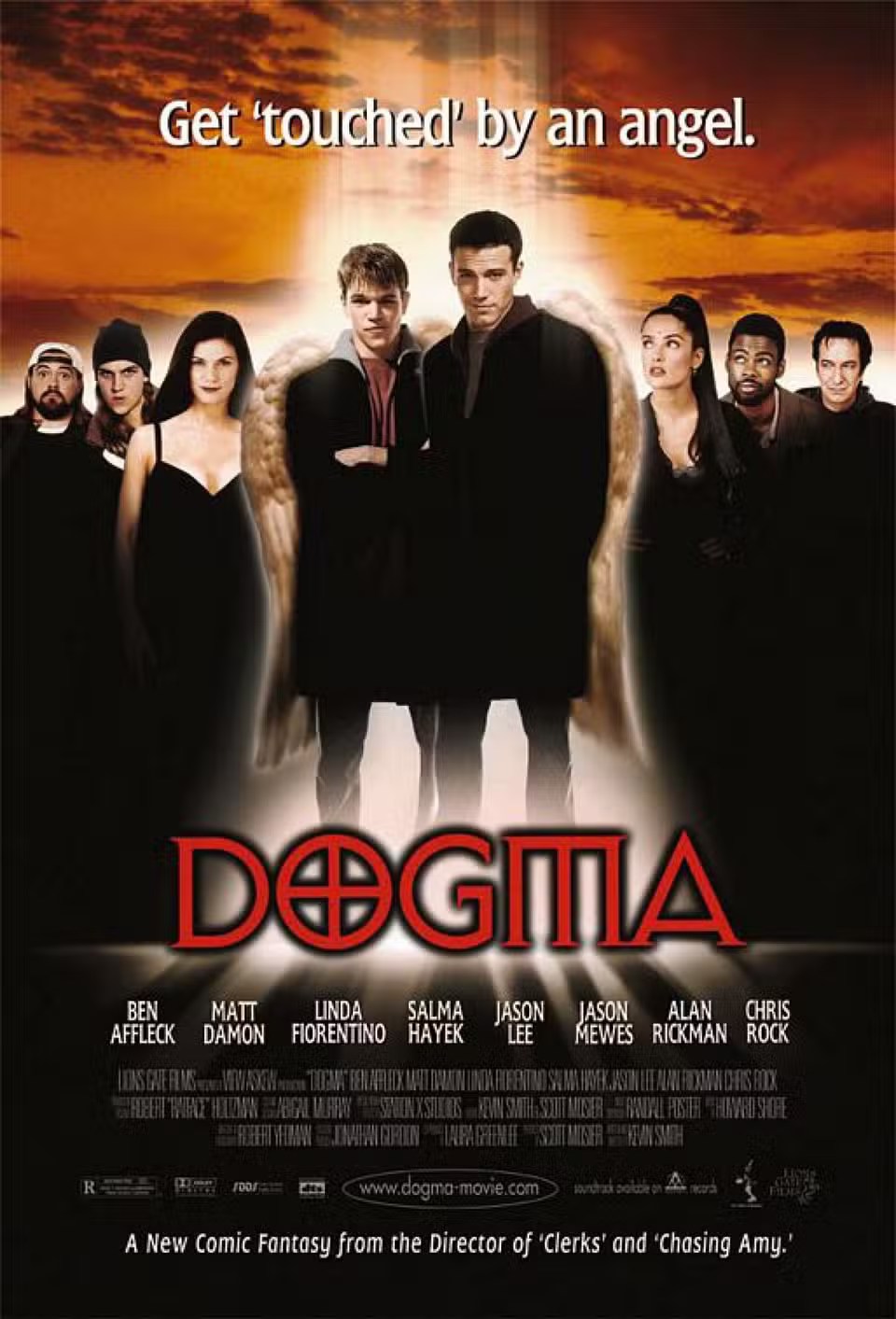
“Dogma” is an almost disjointed mess. Kevin Smith’s “Dogma” came out on Nov 12, 1999. Our world, and understanding of it has changed dramatically, and traumatically since then. (The most stomach-churning example: with Columbine High School massacre, mass or school shootings are a matter-of-course common parlance in the U.S.)
I remember having liked “Dogma” a lot when it came out. Twenty-six years later, I’ve aged, and changed.
Bethany, (Linda Fiorentino) a Catholic who works at an abortion clinic, accidentally happens on an impromptu pilgrimage to a New Jersey church in order to stop and maybe kill two rogue angels before they end humanity.
The best summary of the value of “Dogma” may be critic Ken Turan’s of the Los Angeles Times: “A lively, if uneven, film of ideas that combines a breezy and brazen save-the-world comic fantasy with crude adolescent humor and a sincere exploration of questions of religious faith…”
Maybe I’ve too much silver hair? Part of the unevenness is the gun violence; especially how vilely it’s aged. That morbid circa 2000s beginning of mass shooting phenomena makes the arbitrary violence, especially gun violence, which I can only surmise Mr. Smith meant to be cheeky and satirical, vilely off-key in 2026. In that way this film has aged poorly!
The driving Bartleby and Loki plot, including the anonymous three homicidal hockey boys and Jason Lee’s Azrael, is vital to Bethany’s impromptu pilgrimage. But the duo’s selfish speechifying and references to arcane biblical knowledge distract from the much more compelling, worthwhile and approachable questions and conversations about truth and reality in Bible stories. These, which Chris Rock’s Thirteenth Apostle Rufus and Salma Hayek’s muse Serendipity raise.
The best wake-up moment among the biblical conversations is in a scene on the train between Rufus and no-longer-believer Bethany. Rufus observes that “God still “digs” humanity, “it bothers Him to see the s*** that gets carried out in His name – wars, bigotry, televangelism. But especially the factioning of all the religions. He said humanity took a good idea and, like always, built a belief structure on it.” Bethany asks if he’s saying having beliefs isn’t good.
“I think it’s better to have ideas,” replies Rufus sagely. “You can change an idea. Changing a belief is trickier…” quotation transcribed from “The Independent”.
After this, it seems that Loki is fixated on acting as Angel of Death, which Bartleby tells us he had been. His eagerness and pubescence in meting out righteous penalties to sinners, which Mr. Smith surely meant to be cheeky, isn’t. In 2026, when mass shootings happen as often as paychecks hit direct deposit, it’s tone-deaf!
The third-level problem with Bethany’s every-growing entourage is, like reading a novel like finding new characters added to a already-full roster. It makes it difficult to keep track of or even care about the second-rung characters. Some viewers might want Metatron or Azrael to be more fully drawn. The human wit has finite ”bandwidth”.
As Mr. Smith told Mr. Turan in the Los Angeles Times, “Dogma’ is nothing more than a kick-back, two-hour commercial for Catholic belief, this is a recruitment film for the Catholic Church,” he says with fervor. “This is a pro-faith movie. If one person walks out of the movie and goes back to the church, I’ll have done my job–though that would make the person the most expensive convert ever.”
“No one” watches movies seeking lessons! If that was happening, then the entertainment industry would be far weirder than it is! But, if you were to take one, a middle-ground one, Rufus declaring to Bethany, above that faith and faithful ideas are more worthwhile than installing any religion around any set of “noble” that’s ones is worth walking with.


Leave a Reply