“Hacksaw Ridge” is the feature film that recounts the jaw-dropping actions of Conscientious Cooperator (as Medal of Honor recipient Desmond Doss preferred it) saving at least 75 soldiers from the hellish meatgrinder which was that ridge. The film came out in 2016 on Nov 4th. What’s extraordinary is that, Doss, a Conscientious Objector, was (and probably remains) absent from the high school history texts that I read about World War II.
“Hacksaw Ridge” is divided into two acts. The first one, instead of dramatizing training, recounts Doss’, being pious, fighting the notion of carrying a weapon to the extent of being harassed, hazed and facing a court martial. (AI research shows that the film takes creative liberties.) Creed-oriented, he fought to serve but without a firearm.
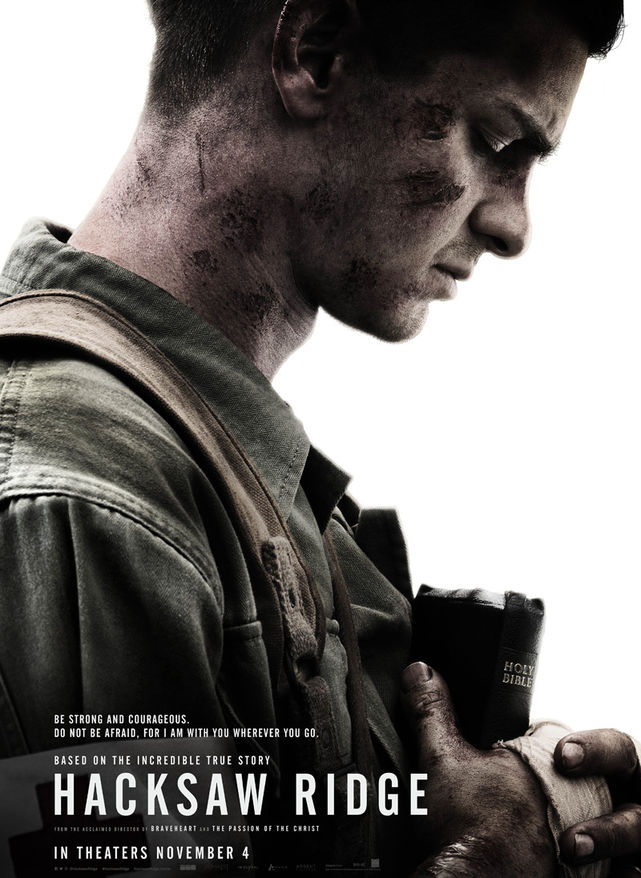
According to Time Magazine, Doss’ rationale was portrayed in “a scene in the movie in which Desmond takes a gun from his father during a fight between his parents is a variation on a similar event in Doss’ life. In reality, it was a fight between Doss’ father and uncle that prompted the boy to vow never to touch a gun again.”
Also per Time Magazine, “Doss viewed himself not as a conscientious objector, but a conscientious cooperator. Unlike objectors, he was eager to wear the uniform, salute the American flag and serve his country. But when he arrived for basic training at Fort Jackson, S.C., he quickly became alienated from his fellow soldiers, and his small stature and soft-spoken demeanor didn’t do him any favors.”
The first act pits Big-Army in a dispute with a recruit over his faith and a mid-20th-Century notion of manhood in wartime, which escalates to court martial. Doss’ squad mates hazed him, assuming that he’d concede then to leave the service. But Doss’ Seventh-day Adventism is a pillar of his creed! The U.S. Army couldn’t understand it.
That history knows anything about Doss is as near miracle as his having lived past the heinous Battle of Okinawa. This because him being humble, according to Screen Daily, “Despite his incredible endeavours, Doss was not interested in seeing his story immortalised on film.
The battle sequences are as intense and off-putting as the opening sequence of “Saving Private Ryan”. According to a Roger Ebert critic, “The second half is set during the Battle of Okinawa, where Doss, who described himself as a “conscientious collaborator” rather than objector, rescued 75 fellow infantrymen injured by the Japanese; it feels like an attempt to one-up the D-Day sequence in “Saving Private Ryan,” and if sheer bloody explosive nastiness were the only measure, you’d have to declare “Hacksaw Ridge” the winner.”
Then, as gnarly as the unrelenting opening sequence of “Saving Private Ryan” was, the second act of this film recounts him tending to dozens of his uniformed brethren. But the miracle was how he survived the Japanese mercilessness!
As mentioned in a North Country Public Radio story, “Veteran Carl Bentley, who was also at Hacksaw Ridge, says in the documentary” “The Conscientious Objector,” ‘It’s as if God had his hand on [Doss’] shoulder. It’s the only explanation I can give.’”
As Roger Ebert critic Matt Seitz wrote, “It’s worth pointing out here that Doss is the child of an alcoholic World War I veteran, Tom (Hugo Weaving). The film’s own contradictions are embodied in Doss’ dad. He preaches the virtues of nonviolence, rails against the romanticizing of war, visits the graves of childhood friends killed at the Battle of Belleau Wood, and doesn’t want Doss or his older brother Hal (Nathaniel Buzolic) to enlist after Pearl Harbor.”
In doing research via Chat GPT, the historical and cultural friction between being manly, and being pious during wartime was rough, and the U.S.’ cultural myopia eye-opening.
Worth noting, the mid-20th-Century concept of manhood was, among other pillars and synonyms of strength, “no man will refuse to carry a rifle in order to defend his country”. Otherwise, most assumed he’s insane, or gay, if not both. The 20th-Century standard was much narrower than the 21st-Century version, which is too Progressive, in my opinion.
The last sober definition I saw of “miracle” is “that, which science cannot explain”. Doss’ squad mate describing that as the reason for Doss’ survival may stand. A devout man driven to serve but without a weapon shows what none of his squad mates could fathom from him.


Leave a Reply