Twin Cities-based author, poet and activist David Mura, discussed Mura’s latest book, “Exit, Miss Saigon: An American Memoir” in the Magers & Quinn bookstore in Uptown on Tues, Oct 20. Mura’s his peer and good friend Alexs D Pate led the conversation.
As the summary of the memoir reads on GoodReads, “David Mura was well into his twenties before he began to explore his Asian American identity.“ “As a result, Mura was raised to consider himself as a white person, and his journey toward understanding and accepting his Asianness was a fraught road―one that left many fractured relationships in its wake.”
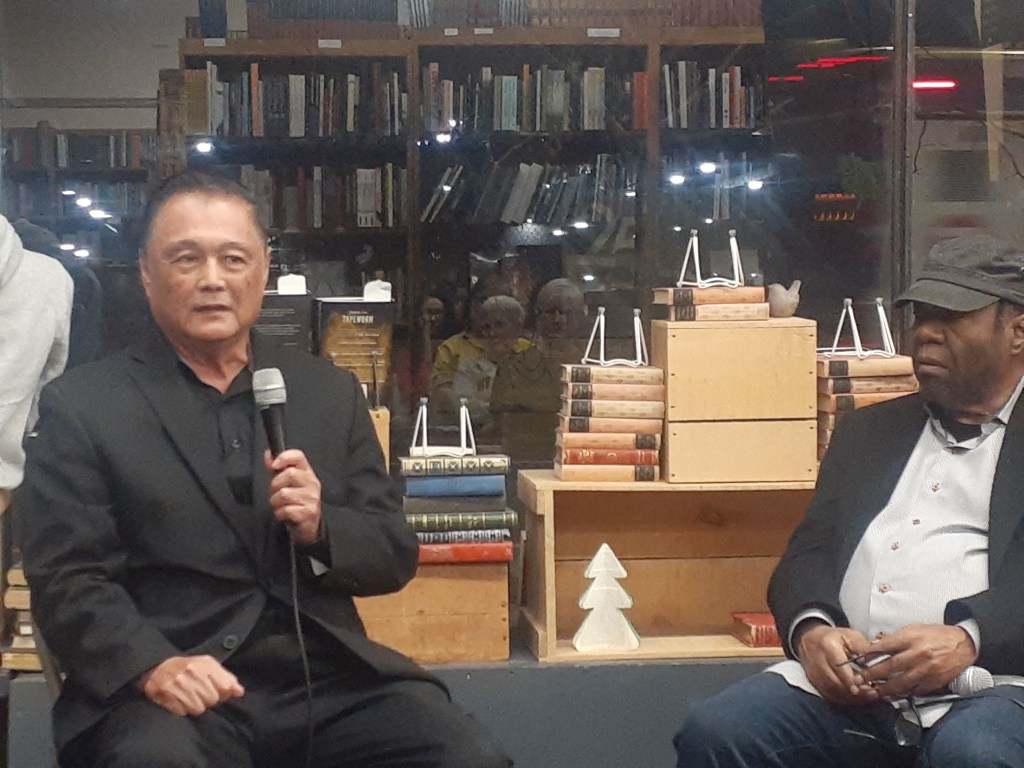
The memoir is a gathering of “essays written over the last 30 years”. “It tells how I transformed from a ‘banana’” into self-knowledge of being Japanese-American.
In his 20s, having been accustomed to seeing himself within whiteness, he “was supported by whites that I thought loved and supported me… Former white friends seem to think I’d transmogrified into an angry Asian writer.”
During the 1990s the Los Angeles Police Department March 1991 assault on Rodney King drove Alexs and David to create a show “Secret Colors” in the Twin Cities. And his writing in 1992 for “Mother Jones,” an essay “What Should I Tell Samantha, My Biracial Daughter, About Secrets and Anger?,” was taken as radical by his white “friends”.
At Magers & Quinn, Mura chose to mix this author event, which was to concentrate on “Exit, Miss Saigon,” with thoughts about the power and impact on his of Alex Pate’s Innocent Project.
Innocent Classroom, created by Alex Pate, taught oft white teachers how to teach Black students who entered many classrooms with stigmas hovering above them; the teachers had ignorance-based biases and assumptions about them. For a while, Mura worked with Innocent Classroom, helping with the training.
“It was my privilege as a middle-class Asian-American not to have to think about these things.” Bigotry. Mura had no ties to the white power structure. “In superficial ways I was just like them (a Black man) as an Asian.” He faces bigots.
Mr. Mura went from having been “raised white,” although he’s clearly Asian, to awakening to himself not being a “banana,” but Japanese-American and the object of bigotry. Eventually he chose to acknowledge bias. In speaking out about this, many “loving and supportive” white artist friends abandoned him. They figured he’d changed into an aggressive radical other.
Becoming more self-aware and befriending Black artists, he claimed a position of what he calls “epistemic humility” when he heard Black artist peers and friends’ gripe about racism. He resolved not to argue against their perceived realities. But to listen.
While the stressors of being Black-American differ from those of being Asian- or Japanese-American, Asians, not being white, remain an other to white culture. During the event, Alexs Pate remembered years-old anxiety; “I had an instant trembling of dread” on I-94. “I was not going anywhere. I was fleeing. It finally occurred to me that I’d killed somebody.
I mean, I’m a Black man…
I had to remind myself that no one’s after me.”
On racial divisions, and whites’ stubbornness about guilt and accountability, the white establishment asked “why can’t Blacks be more like Asians with their heads down and quiet”.
Mura circled back to the vitalness of his peer Alex’s venture, Innocent Classroom. “My book is in a way, my claiming my innocence as an Asian American.” Because what Alex told the teachers that student’s conduct will conform to the bounty of toxic stereotypes, which those teachers were raised and taught to carry in their heads.
Late in the book event, during their back-and-forth Pate gently nudged him to reveal an uneasy truth during the hour; he asked “how did you survive” that abandonment by the white friends?
“In a funny way, they could accept Alex’s racial anger, but not mine,” Mura observed. Ten white artist “friends” abandoned him. Pate observed “this man is not a different man. He’s just seeing the world differently”.
After the abandonment by white “friends,” there was a gap before he resumed artist or activist work. I realized, “I’m writing for white people, if they wanna listen. But my audience, the older writers who let me in, aside from the Asian writers, were all Black writers.”


Leave a Reply