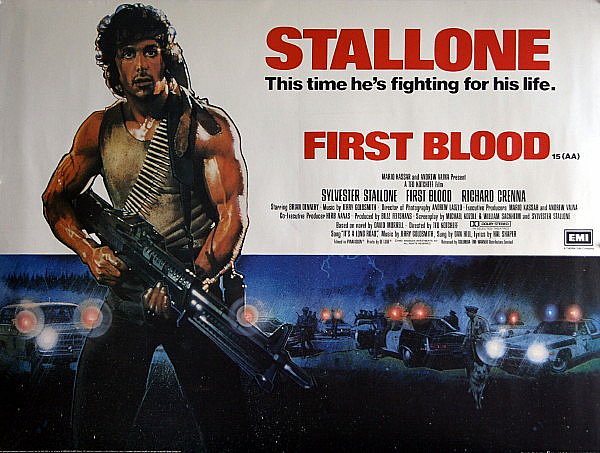
In 1982 “First Blood” came out on October 22nd. It promised to be a typical shoot-‘em-up. You, viewers, wouldn’t need to think while watching the ever more explosive action scenes.
After finishing his tour of duty in Vietnam and leaving the U.S. Army, John Rambo just wants to live life, including reuniting with a former squad mate. The first scene has him visiting his teammate Delmar’s house. He learns that his comrade, whom he’d been eager to reunite with, had died from cancer. It was as a result of Agent Orange. Rambo is newly grieving atop of extant frustration.
‘“First Blood” “is one of those films that isn’t what people think it is,” Will Cox of “The Guardian”. At first glance or seeing the trailer, you’d think that “First Blood” is about a rogue Army vet who’s on a tear of violence! That was what the novel portrays. What surprises most viewers is that, with all the “violence,” there’s only one death. And it’s not intentional at Rambo’s hand. That is how Stallone changed the story’s tone and increased Rambo’s humanity and relatability. “It’s easy to conflate it with the torrent of other Stallone guff from the 80s,” as Mr. Cox observed in 2025.
When I saw this originally as a very young man, somehow I didn’t notice that this Special Forces soldier had restrained himself and his violence in his effort to escape abusive deputies and a bull____ charge and just live a peaceful life.
The schism between the sheriff, and veteran begins with Sheriff Teasle (Brian Dennehy) driving Rambo north across town. During the drive across Hope, WA, Rambo asks “is there somewhere around here where I can get something to eat”
Teasle: Yeah. There’s a diner about 30 miles up the highway.
Rambo: Why are you pushing me?
Resembling a ne’er-do-well or drifter, in Sheriff Teasle’s provincial eyes, wants him gone.
Not having read it, according to Chat GPT research, David Morrell’s novel has Rambo much darker, stacking up a body count of many dozens. His post-service anger makes him basically irredeemable. As reporter Will Cox mentioned in a “The Guardian” article, Stallone “plays a wounded veteran with depth that was later betrayed by a series of xenophobic sequels”.
As James Clark, a senior writer for Task & Purpose observed, Rambo is disparate from both “buldgy-muscled Rambos” of the novel and the sequels,” which omit the emotional weight that Stallone portrays. Yeah. If you’re a serious film-goer and thoughtful, then the balance of the franchise is a cash grab!
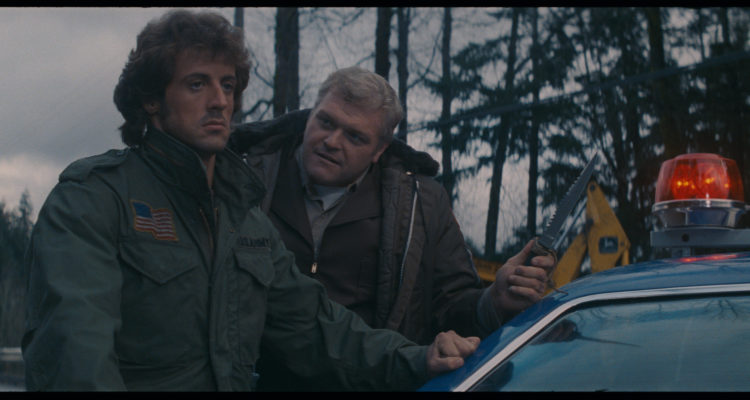
Sheriff Teasle arrests Rambo for vagrancy. The police booking process, and a deputy’s entitled brutality toward him stirs flashbacks and in-turn a fight-or-flight response in Rambo; he fights and escapes.
Amid the pursuit of Rambo, the teletype request (a late-20th-Century means to obtain suspect background info) for backstory on Rambo, which was mentioned while he was being processed, returns. “You picked one helluva guy to mess around with…” Responding to the news, young deputy Mitch (David Caruso) says “a Green Beret. …That’s great. That’s just great!“ Balford (Michael Talbott) says “Those green berets. They’re real badasses”. Mitch: “Why don’t you let the state police handle this?”! Teasle is stubborn and dug-in.
During a lull in the pursuit, Rambo’s former commanding officer, Col. Trautman (Richard Crenna) arrives from Washington, D.C. and speaks to the sheriff. He describes what Rambo is capable of as a Special Forces soldier. Teasle disregards Col. Trautman’s suggestion to diffuse the situation by letting Rambo slip out. Stubborn, Teasle declares that 200 deputies and troopers will engage him. “Are you telling me that 200 men against your boy is a no-win situation for us”!
Trautman: “if you send that many up against him, make sure you have a good supply of body bags.”
The key message: Why keep pushing someone who has already demonstrated both overwhelming ability and a willingness to spare you?
During the woodland manhunt, after several of Rambo’s boobytraps have wounded Teasle’s deputies, Rambo emerges from the brush and puts a knife to Teasle’s neck. “I could’ve killed you. I could’ve killed them all. Don’t push it. Don’t push it. Or I’ll give you a war you won’t believe. Let it go. Let it go”.
Rambo is telling Teasle that his survival is evidence of restraint—not evidence that Rambo is incapable of killing him.
What happens when a man trained to survive a war discovers that the skills that kept him alive have made him incapable of living peacefully afterward? In re-writing the script and in-turn changing the tone and ending, Stallone told Looper he spoke with 20 veterans in order to hear the feelings and stresses. “In 1982 in the final moments of a film that arguable gave movie-goers their first action hero, here’s the star alluding to post-traumatic stress long before those terms entered common conversations,” Task & Purpose. Healthcare only codified PTSD as a disorder two years earlier.
As the film begins to land, Trautman comes to Rambo, declaring “the mission is over”! Younger viewers, who were too young to know or have even heard as children the tumult of that war, had thoughts about this scene, and its resonance to the whole. They who, for whatever reason record and post “reaction videos” to YouTube certain films, have noted in watching the breakdown scene, which the producers fought Stallone against, that, as he unloads his stressors upon Trautman, (a) he never killed anyone and (b) he needs talk therapy. This scene is what the story built to. The novel’s ending is darker.
C Rambo: Nothing is over! Nothing! You just don’t turn it off! It wasn’t my war! You asked me, I didn’t ask you! And I did what I had to do to win! But somebody wouldn’t let us win! And I come back to the world and I see all those maggots at the airport, protesting me, spitting. Calling me baby killer and all kinds of vile crap..!
Trautman: It was a bad time for everyone, Rambo. It’s all in the past now.
Rambo: For you! For me civilian life is nothing! In the field we had a code of honor, you watch my back, I watch yours. Back here there’s nothing!
Then he recounts the morose and tragic memory of his good friend, Danforth, having finally conceded to a Vietnamese boy’s urging for a shoe shine – Only to find that it was booby-trapped. It blew him into chunks.
His friend is blown to pieces all over his body. Danforth is pleading for help. “I wanna go home, Johnny”. “I can’t find his fuckin’ legs”! Rambo pleads to anyone for help! He breaks down into tears and into a hug from Trautman.
The scene is as tear-jerking as the “I could’ve gotten one more” scene from Oscar Schindler in “Schindler’s List”. As cited in Looper, in “The New York Times,” Janet Maslin showed Rambo as a “tormented, misunderstood, amazingly resourceful victim of the Vietnam War, rather than as a sadist or villain” then ending of the film was undeniably a defining moment for Rambo that came from a very real place and helped raised awareness about the issue of PTSD.
Circa 1982 when the film came out, it’s doubtful that the Veterans Administration or any other groups offered and publicized talk therapy to service members and veterans.
That which the trailer promised would be a common shoot-‘em-up conveys extraordinary emotional power and weight. John hadn’t wanted to fight. He’d finished his tour of duty. He was the rare soldier to earn the Medal of Honor while alive. He wanted to live a normal life; whatever “normal” would mean for him – But the people of Hope, WA, and probably prior cities or towns had refused that.


Leave a Reply