1988’s “The Accused,” is a powerful film starring Jodie Foster and Kelly McGillis, that dealt candidly with the offputting subject of gang rape. According to Imdb, it “is based on the March 6, 1983 experience of” 21-year-old Portuguese “Cheryl Araujo who survived a violent gang rape at Big Dan’s Tavern in New Bedford, Massachusetts…”
The opening scene in which Sarah Tobias (Jodie Foster) runs screaming from the bar, frantic, flailing and trying to stop a car in the middle of a two-lane street who’ll take her away is difficult! Meanwhile a college student who witnessed it calls the police on a payphone. He tells the operator that someone was just raped “by three or four guys”. “There was a whole crowd! …Just send somebody”!
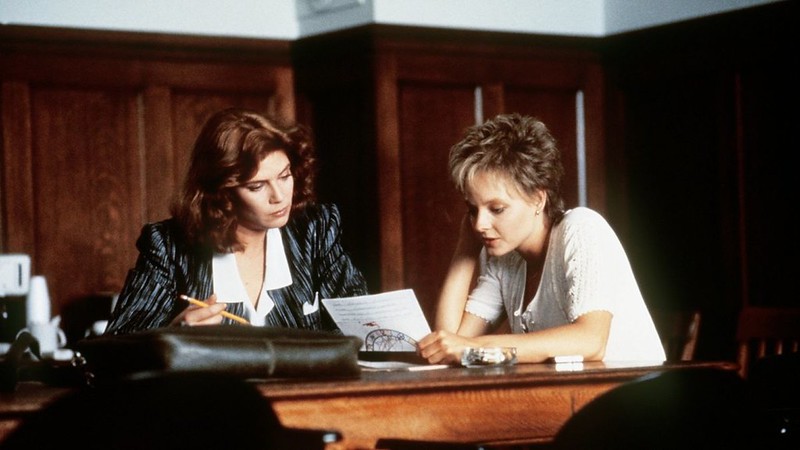
The questions of how Tobias and prosecutor Murphy’s (Kelly McGillis) characters, with almost disparate personalities, can cooperate and build trust across class strata makes them compellingly at-odds as lead characters. Sarah Tobias’ being and speaking common, smoking weed decades before it would be legal, and being open and flirtatious in a bar backroom filled with men, contrasts with Katheryn Murphy’s conservative deportment as a prosecutor.
Sexual violence circa late 1980s was a disparate reality from the 2020s one, which “Law & Order: Special Victims Unit” portrays; that era had no web-centric, social-media-centric culture. Then, jurors and others believed that clothing and make-up choices, and booze intensity could show that the victim was “asking for it”. The 2020s are disparate…
During the first act, main character Sarah Tobias tells prosecutor Katheryn Murphy (Kelly McGillis), “I heard somebody screaming. And it was me”.
Before Ann Burgess (who’s best known in popular and True Crime culture as the basis for Wendy Carr, PhD in Netflix’s “Mindhunter” series) began to speak on her research in Oct 1973 into the nature of sexual violence being about power, not sex, most people, including law enforcement, mistook it as being about sex.
As for sex vs. power, again, according to Imdb, “the gang rape scene was highly controversial at the time of the film’s release. It was the longest, most graphic, and most realistic depiction of a sexual assault in cinematic history. It took five days to rehearse and film, and was a difficult experience for all of the cast and crew involved.”
A turning point, and potentially dire rift between victim and DA, comes after the closed-door sessions with the college students’ lawyers agreeing to plea deals without the “sexual element,” as a lawyer says it. While at her restaurant job, Tobias sees a TV news story that the suspects plead to a crime without the vital and punitive word rape. She is disgusted and feels that that minimizes her and her trauma.
She crosses a social line by (how did she find Murphy’s home address?) going to her home to protest having been dismissed as “not raped”. Murphy’s in the middle of hosting a supper activity with presumably professional-class friends. “Why doesn’t it say ‘Sarah Tobias was raped!’”
Tobias’ protest reverberates in her psyche. Sympathizing, after plenty of research, Murphy decides, against zealous protests from her boss, to pursue and charge the bystanders.
A truth, which North American culture struggles with and the backlash against harmful masculinity may have charged up, remains accepting that “No means no”. For some reasons, dads don’t teach this or young men, amid the confusion of hormones, peer and digital pressures, struggle to accept that “no means no”.
Recent credible research has shown that, among late-20th-Century harmful masculinity, #MeToo and 2020s questions about what is it to be a man, many men are confused about how to be a good one… (There are some toxic “role models”.)


Leave a Reply