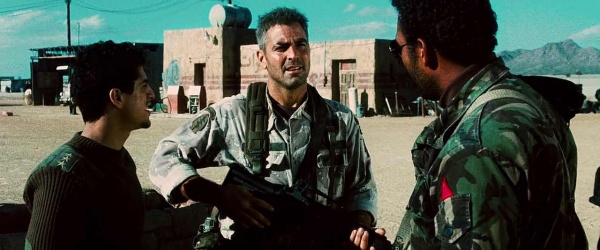
David Russell’s 1999 “Three Kings” is a story of American soldiers in who’ve just ended or “won” a war against Saddam Hussein. The film portrays soldiers doing their jobs, the discombobulation of American foreign policy as soldiers might effect it, and the Big Army derailing the soldiers’ acts of human decency toward civilians after a war’s end.
Four soldiers, (why, as Roger Ebert notes in closing his review, is it not called “Four Kings”?) Major Archie Gates (George Clooney), Sgt. Troy Barlow (Mark Wahlberg) and chief (Ice Cube) and embraced third wheel Private Conrad Vig (Spike Jones), would rather be home in the United States. But someone finds a map to Hussein’s secret and hidden gold. While crude, at best, a soldier found a map to Saddam Hussein’s hidden gold stuck up an Iraqi man’s butt.
Initiated by Barlow, the four begin to think, “hey, the war’s ended. Few of us saw any action. Although none of our bosses has approved it, why not venture to find and seize the good and get rich”! That’s an epitome of Americanism.
Except that war changes realities and rules. And they’re in Iraq among desperate and squalid civilian Iraqis. The effort that Russell puts into portraying the Iraqis as human and faceted is noteworthy. The different groups are motley instead of being one-note “Hajis”.
As Roger Ebert notes, “Three Kings” is a mixture of genres; war, buddy, satire and road trip. Somehow, Russell makes this yarn work. The problems: these soldiers, led by Major Gates, are on a rogue treasure hunt, encountering civilian Iraqis who are struggling to survive and were told by Americans that, with Hussein gone, America will help them.
As is oft so, America was well-intended – But freedom or Democracy mean disparate things depending on either U.S. and Iraq point of view. Iraq has a disparate even opaque culture. The main tragedy is that many Iraqis took American promises to help them after the war as legal-tender. The reality is morose; in 1999 and since (and well before) the U.S. had a long, concrete and documented history of reneging on allies when it suited the state.
In pursuit of the gold, like a road trip, the four soldiers happen upon random scenes of displaced groups of Iraqis who’ve settled anywhere safe and are playing North American music.
During the ride, they don’t happen upon “Hajis” or “Ragheads,” as U.S. Army Psychological Operations would teach them to consider the enemy, but Iraqi civilians. A pillar of the road trip is that Gates, Chief and Barlowe strive to help the Iraqis who had agreed to help them with the gold.
This road trip is one of discovery for the foursome, and the viewers. Circa 1999 how many North Americans had met any Iraqis or North Africans as other than an “other”? Despite what the U.S. Army probably trained its soldiers to “know,” the Iraqis didn’t hate America or want to kill them. “Three Kings” ably shows the banality and boredom, which war can be, how poorly foreign policy trickles down to street-level commanders and grunts who can effect it, and humanity toward innocent indigenous civilians.


Leave a Reply