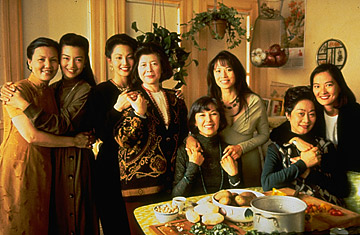
Around Sept 8th or 10th of 1993, 33-years-ago, Wayne Wang made the film adaptation of Amy Tan’s beloved novel “The Joy Luck Club”. In U.S. cinema history Asian-Americans had been struggling for generations for others to see them beyond rigid stereotypes, which white people found most comforting.
Tamlyn Tomita, one of the actors who played one of the daughters in “The Joy Luck Club,” said during a 2018 “Good Morning America” segment, “Ming-Na, myself, and others. During the 1980s how many Vietnamese refugees did I play? I can probably name at least five on the top of my head. That’s how it was.”
Twenty-five years after “The Joy Luck Club,” in 2018 “Crazy Rich Asians” was made. I’ve not seen it. When I saw the trailers, I discerned, “I can’t relate to this”. But it’s great for Asian-American actors and filmmakers!
With “The Joy Luck Club” and “Crazy Rich Asians” succeeding, Asian-American actors feel less jammed into stifling boxes like martial arts, Vietnamese refugee, or incidental “minority” friend roles than before.
In interviews since “The Joy Luck Club,” being better-known, actors Ming-Na Wen, Tamlyn Tomita and Rosalind Chao described contesting white producers’ ignorance and biases about the realities and distinct histories of Okinawan, Chinese and other diasporic cultural details. As Lauren Tom told a reporter, she spoke up on a certain film “because her character’s lines were stereotypical and she refused to say them.
Janet Yang, who was executive producer of “The Joy Luck Club,” and worked for Amblin Entertainment and Oliver Stone’s firm at different times, told “Good Morning America” “…But now I see it (having felt lucky that white execs included her at the decision table) different…” “Like why was it this way?”
The presence and success of “The Joy Luck Club” gave Wen, Chao, Tomita and the rest of the cast higher profiles, which could help their careers. For example, in 1994 Ms. Wen told the “Los Angeles Times” the film’s high profile made her more comfortable and confident to pursue non-Asian-specified roles like Wen’s third-year resident on 1990s juggernaut “ER”. What’s more, cultural embrace of that film made “Crazy Rich Asians” more possible to make.
But, especially with “public servant,” and implicit bigot Trump in office, and the fact that “Everything Everywhere All at Once” is the main Asian-led major film since “Crazy Rich Asians” to find resounding success, the road away from persistent, rigid stereotypes remains difficult and awkward. (I didn’t like or get “Everything Everywhere All at Once”.) When I tried to enjoy it after it received the Best Picture Oscar, I didn’t understand why the filmmaker was choosing to throw too much into what needed to be a cogent story.
At least American films and shows can have Asian and Asian-American actors on-screen without them being confined into too-well-worn trite or toxic roles – Except that, with The Combover in-office, it emboldens many small-minded and happily backward people to expect Asians to do on-screen what whites are most comfy watching!


Leave a Reply