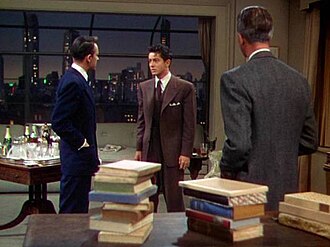
I barely remember the movie “Rope”. The Alfred Hitchcock film with “no cuts” came out in 1948 well before my birth! August 28th marks an anniversary of the film’s release.
As for the real “inspiration” for the film, and self-conscious exercise of snotty young men, 19-year-old Nathan Leopold and 18-year-old Richard Loeb’s, self-perceived brilliance and exceptionalism channeled into the grisly 1924 murder of 14-year-old Bobby Franks.
Leopold and Loeb invested several months in planning to kill 14-year-old Bobby Franks. The affluent, intelligent, above all entitled, egocentric boys, feeling themselves among Nietzschean “Ubermenschs,” desired the challenge of committing “the perfect crime”. An act that would exemplify their Ubermenschness. As a part of this mindset, they believed that being among the Supermen connoted them being exempt from the laws of common society! And a wrinkle that undermines the boys’ aspiration toward superiority is that getting away with the crime was the pivotal driver.
As Mr. Leopold is quoted in Wikipedia, “by his interpretation of Nietzsche’s doctrines, they were not bound by any of society’s normal ethics or rules.[7] In a letter to Loeb, he wrote, “A superman … is, on account of certain superior qualities inherent in him, exempted from the ordinary laws which govern men. He is not liable for anything he may do.”[21]
Beside Leopold’s explanation, a vital bottom line for the egotistical boys in the peculiar milieu of 1924 Chicago (which was Middle America in some minds) was the goal of getting away with the crime. Psychology and knowledge of mental health were nascent circa 1920s. If someone reads about the history of mental health or treatment in that era, then the “state of the art” would make their jaws gape. Ideas were seldom based on established and concrete science.
If we remember that “Rope” is the reason to be reading, the film is a peculiar artifact. At 80-mins a film is barely considered to be feature-length. And reviewers have called the acting stiff or self-conscious, if not both. The production not wanting to waste film cost pressed the actors not to mess up takes. If they did, then the 10-mins portion would have to be recorded anew.
In seeking knowledge and clarity about the boys’ entitlement insanity, the AI tool Perplexity offers, “The clearest way to put it is: Leopold and Loeb turned Nietzsche’s demanding ideal of self-overcoming into a flattering alibi for ego, domination, and immunity from consequences. Their “superman” was a superior rank that entitled them to use other people”. But it seems that for varied reasons, to label the boys as antisocial personality disorder or psychopaths would be hasty! They’re both long-dead and their era is too.
For whatever reason among those who are interested, this is considered to be a queer-oriented film. Decades ago when I saw “Rope,” I don’t remember knowing or caring that the 18- and 19-year-old boys were lovers. Goodness knows what that was like a century before 2024! And, given the Hays Code censorship of the 1940s, everything in “Rope” about gayness was made implicit.
One hundred years after their crime, it’s absurd and impossible to attempt to understand why either one much less both aspired to demonstrate their Ubermensch exceptionality by committing murder..! That moral puzzle or quandary may be the hinge of considering the anniversary of this film’s release. Had the boys made a moral or constructive choice for acting on their “superiority” those youngsters might not be infamous. I don’t know what kind of psyche leaves a person comfy with infamy over anonymity. But that’s probably a facet of criminal psychology.


Leave a Reply