I’ve seen “The Fugitive” since I saw it in a cinema. It came out in 1993 and ultimately earned $369-mil. As could happen back then, it played in theaters for six weeks. I remember a well-paced, propulsive story with well-drawn characters. It had a clear moral compass. Until I read a retrospective article about the legacy, I’d forgotten that Jane Lynch was in it!
As a biracial Black man, it’s sad that I remember no substantial Black character in this – there was the assistant U.S. Marshal Poole, played by L. Scott Caldwell. Aside from her, I remember the inmate whom Kimble meets for 20 seconds. As Kimble’s saying goodbye in the jail visiting area, the inmate says “we might as well talk about something! Ain’t got no cable in here”!
“The Fugitive” is a chase film that worked well.
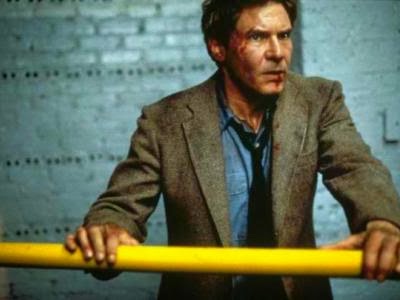
Being older now, it reminds me how disappointed I am that, aside from Richard Roundtree’s “Shaft,” I can’t think of a Black thriller hero. And “Shaft” doesn’t count; it wasn’t framed as a chase story. Only after asking Google Gemini, am I reminded that 1998’s ”Enemy of the State,” with Will Smith is among the circa 1990s rivals to “The Fugitive”.
In the 2020s, after the killing of George Floyd, and with police body cameras almost ubiquitous, it’d be difficult or awkward to create a chase thriller that crosses racial lines. This, especially with Don Trump and its acolytes railing against the “reverse racism” of Black Americans more often tasting equal slices of success while whites seemingly taste less.
The smart Black thriller films that Gemini listed include “Collateral” with Jamie Fox, “Unstoppable,” with Denzel Washington and “Tenet,” with his son John D. Washington. A problem: aside from “Collateral,” I’d neither heard of nor seen them.
A wrinkle is discerning which titles compare well as equal to the pacing of the drama in “The Fugitive”. I forgot that “U.S. Marshals,” with Wesley Snipes came out. The trailer didn’t grab me. I probably saw it as a Hollywood money grab after the success of “The Fugitive”. “Die Hard with a Vengeance,” with Sam Jackson, was the second sequel to “Die Hard,” also a money grab from Hollywood. I don’t remember it as being compelling in terms of either story or well-drawn characters!
Now 32 years after “Enemy of the State” came out in 1998, I remember it somewhat well. It might be a great chase yarn. You had an educated and articulate Black man as the hero. With nagging toxic stereotypes of Black families hobbling because of absent dads, Dean is a competent and engaged one. It’s a welcome counterpoint.
Instead of Dean being sought by a U.S. Marshal for murder as Kimble was in “The Fugitive,” he’s sought by people of the National Security Agency related, it seems to the killing of a U.S. lawmaker. Dean, with a man named Brill’s, played by Gene Hackman, help identifies then evades the NSA’s surveillance-oriented search-and-kill effort (a “standard training op”) to find him. According to trivia on Imdb, this film was three years before the Patriot Act became real. In the SnapChat era, “Enemy of the State” seems quaint.
In an era with thriller and chase yarns that have ever larger explosions in order to keep our attention, I recall none in “Enemy of the State”. Instead of relying on explosives, the hurdles are the ever more devious surveillance tactics which his pursuers employ. The U.S. Marshals’ hard-target pursuit of Kimble might be more compelling because of the pharma conspiracy. That might be the decisive reason why Kimble seems to be a more fully-drawn character in some viewer’s minds than Dean.


Leave a Reply