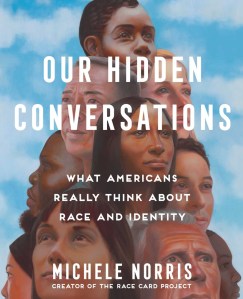
Michele Norris, a journalist probably best known as a one-time co-host of National Public Radio’s “All Things Considered,” has written another book. It does that, which many of us aspire to, but rarely do. It confronts “Our Hidden Conversations“ (the title of the book) about race. We are cautious about race.
From the beginning of The Race Card Project, which she began in 2010, Ms. Norris encouraged Americans to write six words about race.
Later, she and The Race Card Project nudged them to elaborate by asking “anything else”. Today the book recounts the state of race after Pres. Obama’s election as a “post-racial” harbinger, through the changes which Mr. Trump wrought.
Now, after Don Trump’s first term as Mr. Obama’s successor, and some Minneapolis Police officers murdered George Floyd during that term, we have rubber-necked back to whatever state of race preceded the “post-racial” one. The bitter vitriol in the U.S. about race, oppression and guilt means that clearly we avoid talking about race. News headlines and viral social media post convince us this.
But on January 16, Ms. Norris promoted “Our Hidden Conversations“ on “CBS Mornings” saying “I wrote this because I thought that no one wanted to talk about race. I was wrong”. Some of us will open us about race as long as were not marked with “them”.
After Pres. Obama’s two “post-racial” terms, voters chose Don Trump to succeed him. He is a flamboyant narcissist who carries a bounty of vices. Those of us who are offended by the 45th president’s conduct. Many of us call those who support that person “them”.
From Jan 15 NPR interview with Norris, here are examples of some six words:
“no, really, where are you from?”
ALEX SUGIURA
“with kids, I’m dad – alone, thug.”
MARC QUARLES
No one wants to be called “them”.
“‘Them’ is the most dangerous word.” Ms. Norris said on “CBS Mornings,” that “people are desperate to talk about race within the prism of personal experience”.
My personal experience has taught me that to stay silent until that stranger shows his or her openness is the least stressful tack to take.
Changes of mind, of heart, and expansions of world view can begin with six words. We’re eager to go past race and its ism; at least Conservatives zealously argue for this. We mistake the impulse or reflex, emotional recoil against the subject for a yearning to avoid it.
So, a reality is that we want to talk race – but as she observed “in a safe space”.
Changes of mind, of heart, and expansions of world view can begin with six words. The conversation is difficult even fraught because whites and others have varied and seemingly ossified emotional reflexes.
Today, as digital culture (e.g., social media) reigns, few people seem to walk far enough to learn beyond another person’s surface. As the novel “To Kill a Mockingbird” instructed us, it is better to “walk in another man’s shoes before judging him”.
 Will Wright: Award-Winning Independent Journalism, Exec Oratory and More...
Leave a comment